
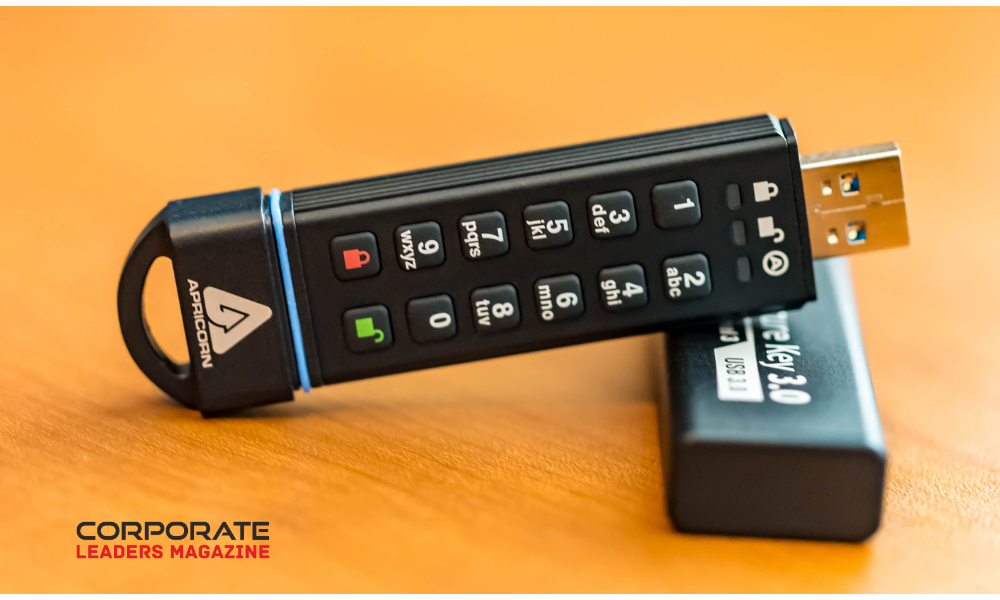
Key Highlights
- Apricorn has launched a 4TB version of its Aegis Secure Key 3, offering one of the highest-capacity hardware-encrypted USB drives available.
- The device combines mini-SSD architecture with hardware-based encryption to deliver higher storage capacity, faster performance, and enhanced portability.
- Designed for security-focused industries, the drive has been submitted for FIPS 140-3 Level 3 validation.
As organizations generate larger volumes of sensitive data, the need for portable storage devices that offer both high capacity and strong security continues to grow.
Addressing this demand, Apricorn has introduced the 4TB Aegis Secure Key 3 (ASK3), expanding its lineup of hardware-encrypted storage solutions with a device that combines enterprise-grade protection and flash drive portability.
The new model significantly increases available storage while retaining the compact form factor expected from a USB drive. Built on a mini solid-state drive architecture, the device delivers substantially more capacity than conventional hardware-encrypted flash drives, making it suitable for organizations that routinely transport large volumes of confidential information.
Higher Capacity Meets Faster Performance
The latest ASK3 incorporates several hardware improvements aimed at enhancing both speed and reliability. A new bridge controller enables faster data transfers, with Apricorn reporting read speeds up to 31% faster and write speeds up to 16% faster than the previous generation.
Unlike traditional USB storage devices that rely on software for security, the ASK3 uses hardware-based encryption and software-free authentication. This approach allows organizations to protect sensitive information without depending on operating-system-specific security applications.
“As organizations generate and move larger amounts of sensitive data than ever before, they need solutions that scale without sacrificing protection,” said Jeanclaude Toma, CEO of Apricorn.
“The new 4TB ASK3 reflects that need and demonstrates what is possible when innovation is driven by real customer demand, whether supporting fully offline edge systems or cloud-connected environments where transporting terabytes of secure data over wide area networks is impractical.
“As data footprints at the edge continue to grow, this device delivers greater capacity in a form factor that fits in the palm of your hand.”
Designed for High-Security Environments
The 4TB model has been engineered to meet the requirements for FIPS 140-3 Level 3 validation and has been submitted to the National Institute of Standards and Technology’s Cryptographic Module Validation Program (CMVP).
The device targets organizations that handle highly sensitive information, including government agencies, defense organizations, healthcare providers, financial institutions, legal firms, and digital forensic teams.
To improve durability, the drive also incorporates an environmental protection system that monitors operating conditions and automatically shuts down if unsafe temperature or electrical conditions are detected. Normal operation resumes once conditions stabilize, helping safeguard both the device and the encrypted data it contains.
Built for Secure Data Mobility
Apricorn says the combination of high-capacity storage, hardware encryption, and rugged design makes the device suitable for professionals working across offices, remote locations, and field environments where secure data transport is essential.
“There has never been a hardware-encrypted USB drive this small with this much storage,” said Kurt Markley, Managing Director of Apricorn.
“Customers asked us for more capacity without giving up the convenience of carrying a secure drive in their pocket, and that is exactly what we built. The 4TB ASK3 combines the ruggedness customers expect from Apricorn with super-fast performance and a design that meets and exceeds FIPS 140-3 Level 3 requirements. Whether it is traveling between offices, supporting field operations, or moving sensitive files in harsh environments, this device is built to go wherever the data needs to go.”