
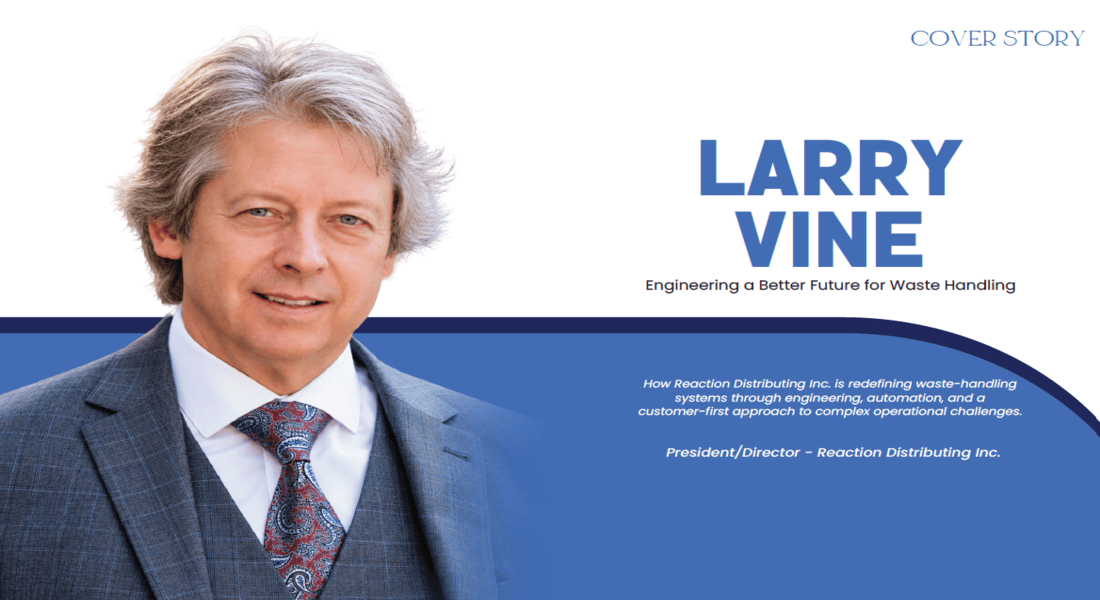
How Reaction Distributing Inc. is redefining waste-handling systems through engineering, automation, and a customer-first approach to complex operational challenges.
In many industries, progress begins when someone questions a familiar way of doing things. For Larry Vine, President and Director of Reaction Distributing Inc. (RDI), that moment came well before the company was founded in 1993. His experience working with a waste-handling equipment manufacturer revealed a gap between supplying machinery and solving the operational problems customers faced every day.
Hired in 1989 by an existing manufacturer to increase sales and market share, Vine gained a close understanding of the equipment available to the industry. Yet he also recognized that individual machines, even when they performed as intended, could fall short of addressing the needs of an entire facility.
“It became increasingly clear to me that something important was missing,” Vine explains in describing the thinking behind RDI.
“The industry was very good at manufacturing and selling individual pieces of equipment, but there was far less emphasis on understanding how those pieces of equipment integrated into a customer’s complete waste-handling process,” Vine explains.
He believed the industry needed a different perspective. Instead of beginning with a product, the design process should begin with the customer’s operation, the challenges within it, and the improvements that could make a meaningful difference.
That conviction became the foundation of Reaction Distributing Inc. and its approach to systems design. Vine’s objective was to provide a “better solution,” one that considered the entire waste-handling process rather than treating each piece of equipment as an isolated purchase.
More than three decades later, this principle remains central to the company’s work. RDI’s projects have grown in scale and complexity, particularly in healthcare and other demanding environments, but its underlying philosophy remains consistent: understand the problem first, then engineer the right solution.
From Equipment Supplier to Systems Solutions Provider
Reaction Distributing’s evolution reflects a broader shift in how waste handling is understood within modern facilities. What was once frequently treated as a collection of separate equipment requirements has become an integrated operational consideration involving material movement, labour, safety, automation, building infrastructure, and long-term performance.
For Vine, engineering is the link that brings these requirements together.
“Today, RDI has evolved from an equipment supplier into a fully integrated systems solutions provider,” he says. The company designs, manufactures, installs, commissions, and services complete waste and recycling systems, drawing on the expertise of its sales, engineering, manufacturing, installation, and service teams.
This integrated model allows RDI to evaluate the wider consequences of a design decision. A compactor or baler may be appropriate for a particular application, but its value depends partly on how effectively it works with the facility around it. The movement of waste, available space, operator responsibilities, collection frequency, and the building’s technical requirements all influence the final result.
RDI’s approach therefore places the overall operation ahead of any individual equipment recommendation. The objective is to determine how the system can function more effectively as a whole.
“Our ability to successfully address these increasingly complex requirements has strengthened RDI’s reputation and opened opportunities across Canada and into the United States,” Vine says.
He also points to growing demand in Canada’s healthcare sector, where new hospital projects create complex requirements that cannot be addressed through conventional equipment selection alone. These projects have helped demonstrate the value of RDI’s engineering-led model and strengthened its position in the market.
Designing Around the Customer’s Reality
No two facilities operate in exactly the same way. Waste volumes, building layouts, material types, staffing requirements, safety considerations, and collection arrangements can vary significantly. A solution that works well in one environment may be unsuitable for another.
RDI’s design process reflects this reality. Rather than relying on a standard equipment configuration, the team examines the client’s specific requirements and explores possible approaches before arriving at a final design.
“Our experience with major hospital projects has demonstrated the value of our holistic approach, particularly where waste-handling systems must interact with automated material movement, multiple waste streams, building pressure, security and other critical infrastructure,” Vine explains.
Projects are discussed internally with contributions from sales, manufacturing, engineering, and installation personnel. This collaborative process allows the company to consider the practical implications of a design before it moves into manufacturing and installation.
The approach is especially valuable when customers have requirements that interact with one another. Increasing automation, for example, may reduce manual handling, but it must be implemented in a way that maintains safety, accommodates the available space, and works reliably within the facility’s wider operating environment.
RDI also seeks to identify issues customers may not have initially considered. Its objective is not simply to fulfil a specification but to understand whether the proposed system addresses the underlying operational challenge.
“Each group looks at the project from a different perspective, which helps us identify potential issues before they become problems in the field.”
This perspective helps explain why total system integration is central to the company’s identity. The value lies in understanding how the individual components work together and how the completed system can improve day-to-day operations.
Technology That Makes Better Design Possible
Technology has expanded RDI’s ability to plan and deliver sophisticated waste-handling systems. Among the tools central to its design process are three-dimensional modelling, LiDAR scanning, PLC-based controls, automation, and monitoring capabilities.
Three-dimensional modelling allows engineers and customers to examine proposed layouts from multiple perspectives before manufacturing begins. Potential conflicts between equipment and building infrastructure can be identified during the design stage, reducing the risk of discovering costly problems during installation.
For particularly complicated projects, RDI uses LiDAR to create accurate models of existing facilities. These models provide a practical basis for developing equipment solutions within real-world spatial constraints.
Vine highlights the operational benefits of this approach, explaining that the technology can accelerate design, manufacturing, and installation while providing customers with a model of the final design to retain.
Controls and monitoring have also changed what modern systems can accomplish. PLC-based technology allows equipment to operate through coordinated sequences, while monitoring capabilities provide greater visibility into system performance and container capacity.
These developments can help customers manage waste-handling operations more effectively. Monitoring container fullness, for example, can support better collection planning and help avoid unnecessary trips when containers have not reached their practical capacity.
Technology, however, is not an end in itself. Its value depends on how effectively it solves the customer’s problem.
For RDI, the priority remains to combine engineering knowledge with appropriate technology to create systems that are safer, more efficient, and better suited to the facility in which they operate.
Efficiency and Sustainability Go Hand in Hand
Sustainability in waste handling is often discussed in terms of recycling and waste diversion. Yet the equipment and processes used to collect, compact, store, and transport waste also influence a facility’s environmental footprint.
RDI approaches this challenge through operational efficiency. Systems that achieve higher payloads can reduce the number of collections required. Monitoring capabilities can help ensure containers are used effectively, while more efficient hydraulic power units can reduce equipment running time and electricity consumption.
Equipment reliability also matters. Fewer component failures can mean fewer replacement parts and service visits. A longer working life can reduce the frequency with which customers need to replace major equipment.
Vine describes this as a practical way to connect engineering decisions with environmental outcomes. A well-designed system can improve everyday performance while reducing avoidable resource use over its operating life.
The benefits extend beyond energy consumption. By reducing the labour associated with repetitive waste movement and improving equipment integration, automation can also make operations more manageable while supporting operator safety.
These gains are particularly relevant in large facilities where waste handling involves numerous internal movements and several interconnected processes. Small improvements in individual tasks can become more significant when sustained across an entire operation.
For RDI, sustainability is therefore closely tied to how effectively the system has been designed. Equipment performance, transportation requirements, maintenance needs, and service life all contribute to its overall impact.
When Complex Projects Demand Flexible Thinking
Healthcare facilities provide a clear example of the challenges involved in modern waste-handling design. Hospitals must accommodate multiple waste streams while maintaining demanding operational requirements. Waste movement may need to work alongside automated guided vehicles, building pressure systems, security arrangements, and other building technologies.
Vine recalls a healthcare project that significantly tested RDI’s design process. The customer had several essential requirements that added layers of complexity to the final solution. These included maintaining building pressure, accommodating automated guided vehicle-based waste transfer carts, maximizing back-of-house security, increasing automation and efficiency, and prioritizing operator safety.
The challenge was not simply to select suitable equipment. It was to integrate all these requirements into a single, coordinated system.
Experiences like this reinforce the importance of flexibility. Complex projects can introduce requirements that cannot be accommodated through a rigid or conventional design process. Engineers must be prepared to reassess layouts, evaluate alternatives, and consider how one decision affects the rest of the system.
RDI’s holistic approach gives the company a framework for handling these challenges. By involving different departments and considering the complete facility, the team can work toward a solution that addresses the customer’s requirements as a connected whole.
This flexibility has become increasingly important as customer expectations evolve. Rather than viewing additional requirements as barriers, Vine sees them as opportunities to apply engineering experience to more demanding problems.
Vine says, “as our customers demand more from their waste-handling systems, our responsibility is to ensure that our designs continue to deliver more.”
Leadership Built on Trust and Expertise
Behind RDI’s engineering-led approach is a leadership philosophy that places considerable importance on the people responsible for delivering the work.
Vine believes employees perform best when they have the expertise, resources, and authority to contribute meaningfully to their responsibilities. Rather than centralizing every decision, he encourages team members to use their professional knowledge and develop solutions within their areas of expertise.
The philosophy is supported by a strong emphasis on engineering involvement. Design decisions must consider fabrication, installation, and practical performance, not merely whether a concept looks appropriate on paper.
“Nothing happens at RDI unless engineering has been involved,” Vine explains, emphasizing the importance of engineering in achieving effective designs, sound fabrication principles, and successful installations.
This collaboration also helps the company adapt when circumstances change. Vine points to the pandemic as an example of how the company’s continued focus on engineering helped it respond to disruption and emerge stronger.
For him, leadership means providing direction while allowing capable people to do their jobs. The company’s progress depends on the combined knowledge of its employees and their willingness to solve difficult problems together.
That approach also supports continuous improvement. When sales, engineering, manufacturing, installation, and service teams share their perspectives, the organization can identify opportunities to improve a design before problems arise in the field.
Looking Ahead: The Best, Not the Biggest
As waste volumes, environmental expectations, labour pressures, and technology continue to influence the industry, the demands placed on waste-handling systems are likely to become more sophisticated.
RDI’s future strategy is grounded in the same philosophy that shaped its beginnings: concentrate on engineering capability and the quality of the solution rather than pursuing size for its own sake.
“At RDI we strive not to be the biggest but to be the best,” Vine says. “The best systems solution provider possible.”
The company sees opportunities in technically challenging projects that require more than conventional equipment configurations. Healthcare remains an important area, while its experience and engineering capabilities have also created opportunities beyond its traditional Canadian market, including in the United States.
Continuing to develop its people and transfer institutional knowledge to the next generation of leadership will be important to sustaining that progress. As projects grow in complexity, the company must ensure its engineering, manufacturing, installation, and service capabilities remain aligned with customer expectations.
Vine also hopes RDI can influence how the industry approaches waste handling during building design. Considering waste movement and equipment integration early in the planning process can help avoid space limitations, inefficient material flows, and operational compromises later.
The ambition is not simply to deliver more equipment. It is to demonstrate what becomes possible when waste handling is treated as an essential part of a facility’s infrastructure.
The Enduring Value of a Better Solution
Reaction Distributing Inc.’s story began with a question about whether the industry could do more for its customers. Larry Vine’s answer was to build a company around a different starting point: understand the complete problem before deciding what equipment is needed.
That philosophy continues to guide RDI’s work across engineering, system integration, technology, sustainability, and customer collaboration. It informs how the company approaches complex projects and how its teams evaluate opportunities to improve performance.
In a sector where operational demands continue to change, the ability to see the bigger picture can be a decisive advantage. Individual machines remain important, but their greatest value emerges when they function as part of a carefully engineered system.
For Vine, success is measured by the quality of that system and the difference it makes to the customer’s operation.
More than three decades after RDI’s founding, the original ambition remains intact: to deliver a better solution, one designed around the customer’s needs and built to perform as part of the whole.
About Reaction Distributing Inc.
Reaction Distributing Inc. (RDI) was founded in 1993. It is a Canadian provider of integrated waste-handling and recycling systems. The company designs, manufactures, installs, commissions, and services solutions for diverse facilities, focusing on engineering excellence, automation, operator safety, operational efficiency, and sustainability.
Company Details
- Company Name: Reaction Distributing Inc.
- Founding Year: 1993
- Office Locations: 95 Woodworth Avenue, St. Thomas, Ontario and 19 Brock Street, Ajax, Ontario
- Official Website: www.reactiondistributing.com
- Industry/ Sector: Solid waste handling equipment
Featured Leader’s Profile
- Name of the Featured Leader: Larry Vine
- Designation: President/Director
- Brief Background & Experience: 40 years of sales, design, manufacturing and leadership experience
Company Highlights
- Key Services/Offerings: Design, manufacturing, installation and service of holistic/integrated solid waste handling systems
- Major Achievements or Recognitions: 2026 top waste handling equipment manufacturer in Canada as chosen by Environmental Business Review magazine, featured on the 2026 Globe and Mail list of fastest growing Canadian companies.