
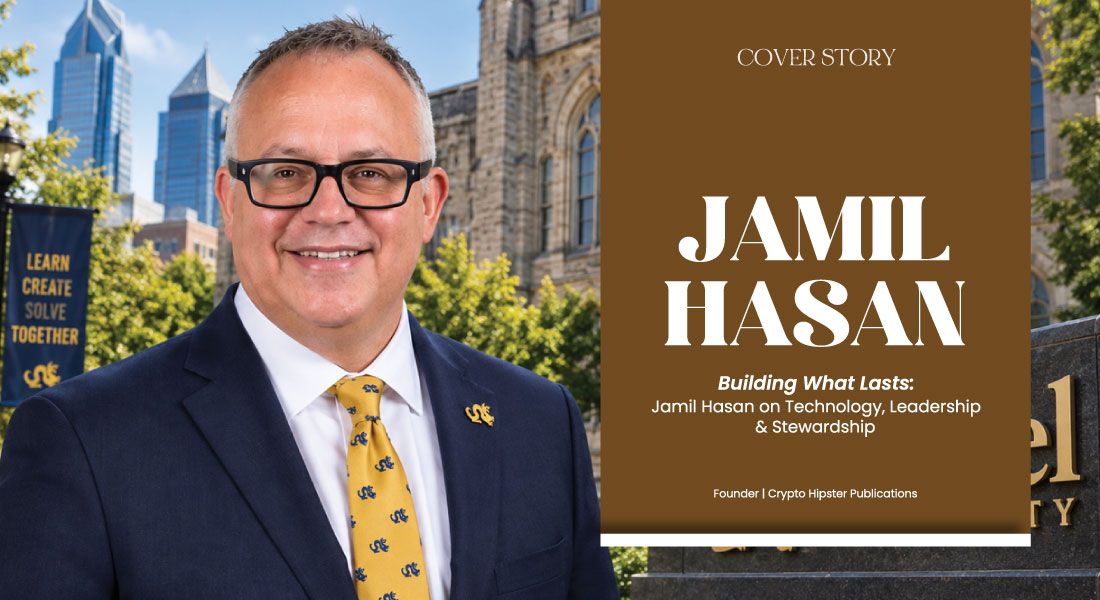
From finance and crypto to publishing, leadership frameworks, and emerging AI, Jamil Hasan’s work has followed one consistent question: what happens when the systems we build become the responsibility of those who come after us?
Through Crypto Hipster Publications and his broader body of work, Hasan explores the human forces behind technology, leadership, trust, and change.
A Career Built Through Curiosity
Jamil Hasan doesn’t describe his career as something he mapped out in advance. It evolved, one chapter pulling him into the next, from years spent working inside financial institutions, including AIG, where he saw firsthand how technology, risk, regulation, governance, and people interact, particularly when systems come under pressure.
“That experience taught me that institutions may be represented by balance sheets, technology, and organizational charts, but people ultimately determine how well they function,” Hasan says. Trust, judgment, relationships, resilience, and institutional memory, he adds, become especially important during periods of disruption.
When he entered crypto in 2017, he recognized many of those same dynamics playing out in a completely different environment. Blockchain promised new ways to organize trust, ownership, and value, but behind every system were still people making decisions. That realization eventually led to the Crypto Hipster Podcast, and later, to publishing.
“What appear to be different chapters of my career,” he says, “are really an exploration of the same question: how do we build systems that serve people and endure change?”
Why Crypto Hipster Publications
Crypto Hipster Publications grew from a conviction Hasan has held since his earliest interviews: that the most interesting stories in emerging technology are usually about people, not products or prices. Through the Crypto Hipster Podcast, he found himself speaking with founders, builders, artists, and entrepreneurs whose experiences often revealed far more about innovation than the technology itself.
“I wanted to create a platform where those conversations could become something lasting,” he says. “Publishing gave me the ability to connect different voices, industries, and experiences while adding my own perspective.”
What he wanted to do differently was resist the constant chase for the next headline or market narrative. Technology changes quickly, but questions about trust, leadership, creativity, failure, responsibility, and purpose endure. “Crypto Hipster Publications, therefore, became less about covering an industry,” Hasan says, “and more about documenting the people navigating change, and exploring what their experiences can teach the rest of us.”
What Hundreds of Conversations Taught Him About Leadership
Hasan has interviewed hundreds of founders and builders over the course of his podcast and publishing work, and the pattern he keeps noticing has little to do with credentials or polish. “Successful leadership rarely looks as polished from the inside as it does from the outside,” he says. “The people I find most compelling are not those who claim to have every answer. They are curious, adaptable, willing to listen, and capable of changing direction when new information challenges their assumptions.”
What stands out to him just as much is what rarely shows up on a balance sheet: trust, relationships, judgment, resilience, credibility, and the ability to make people feel that their contribution matters. “Technology can create extraordinary leverage,” he says, “but it cannot replace those qualities.”
For Hasan, the strongest leaders understand that their responsibility extends well beyond a successful product or organization. They’re also building cultures, relationships, and systems that other people will eventually inherit. “Leadership becomes most meaningful,” he says, “when the question changes from ‘What can I build?’ to ‘What am I leaving behind?'”
Paint What’s Invisible
Hasan believes innovation is never purely technical. “People bring history, fear, ambition, relationships, loss, resilience, creativity, and identity into everything they build,” he says.
That idea sits at the center of his Emotional Assets framework, introduced in Riding It All to Zero, which examines forms of value, trust, relationships, belonging, judgment, and resilience that traditional measures often overlook. Animals, Monsters, and Unclaimed Baggage takes the exploration further, looking at what people carry from their experiences and how those experiences shape them.
He thinks of the broader practice as Paint What’s Invisible. “Leaders are trained to see revenue, technology, productivity, and measurable performance,” he says. “I am increasingly interested in what exists underneath those things.”
Stories, he says, make those invisible forces visible. “When we understand what someone has carried, lost, protected, or overcome, we begin to understand not only the person differently, but also the decisions, organizations, and systems they create.”
Refusing to Be Defined by One Box
Building an independent platform and personal brand brought its own difficulty, and for Hasan, the biggest one was resisting the temptation to become what other people expected him to be. “Crypto suggested one identity. Publishing suggested another. My corporate background suggested something else. Building independently gave me permission to connect them.”
He eventually stopped asking whether an idea fit neatly inside his brand, and started asking whether it belonged to the larger body of work he was creating. “That changed everything,” he says. “A conversation about blockchain, a book about loss and resilience, a leadership framework, or even a children’s story can look unrelated until you recognize the common thread: people navigating systems and change.”
“I overcame the challenge by allowing curiosity to create the platform rather than forcing the platform to constrain my curiosity,” he says. “That freedom has become one of my greatest advantages. My work can evolve because I no longer need every new idea to resemble the one that came before it.”
What Crypto Taught Him About Trust
When Hasan entered crypto in 2017, he was fascinated by the assets themselves and by the possibility that blockchain could challenge traditional financial systems. Experience gradually shifted his attention from the assets to the systems around them.
“I have lived through extraordinary gains, significant losses, failed platforms, technological breakthroughs, and multiple market cycles,” he says. “Those experiences taught me that decentralization does not eliminate trust, governance, incentives, or human behavior. It simply reorganizes them.”
Today, he says, he is less interested in asking what a cryptocurrency might be worth, and more interested in what is being built, who benefits, where responsibility resides, and whether a system can endure when conditions change. “I still believe the technology can transform industries,” he says. “I simply believe its success will ultimately depend as much on people and governance as on code.”
What AI Will Become to Us
Most conversations about AI, Hasan notes, focus on what it is, what it can do, or what it will eventually do. He’s become far more interested in a different question: what kind of relationships will people develop with AI agents? That question is shaping an agentic AI book on his roadmap for the second quarter of 2027.
“As agents become more autonomous, persistent, and involved in our work and decisions, issues of trust, identity, accountability, ownership, and even emotional attachment become increasingly important,” he says. He sees blockchain contributing infrastructure for verification, provenance, identity, and transactions between people and agents, but is quick to add that technology is only part of the story.
“This connects directly to my work around Emotional Assets and Paint What’s Invisible,” he says. “If people begin forming meaningful working relationships with agents, leadership must understand what is happening beneath the technology. The future of AI will not only be about what agents can do. It will also be about what they become to us.”
The Misconception Hasan Wants Leaders to Reconsider
Ask Hasan what business leaders most often get wrong about emerging technology, and he doesn’t hesitate: the assumption that adopting new technology automatically makes an organization innovative. “Technology can change what an organization can do,” he says, “but it cannot determine why it should do it or how responsibly it will use that capability.”
AI, blockchain, and other emerging technologies, in his view, amplify the systems and people already in place. “Strong leadership can use them to create extraordinary value; weak leadership can use the same tools to scale existing problems.” That is why his own attention has increasingly shifted from innovation toward stewardship. “The important question for leaders is no longer simply, ‘What can this technology enable?'” he says. “It is also, ‘What are we responsible for once it does?'”
The STEWARD Framework
That shift eventually gave rise to a leadership framework Hasan calls STEWARD: Stewardship Over Ownership, Trust Under Pressure, Embracing Change with Purpose, Wisdom in Systems, Adaptation for Tomorrow, Resilience with Meaning, and Defending What Matters.
“Those principles emerged from experience rather than theory,” he says. “I have watched institutions navigate crises, participated in multiple crypto cycles, experienced significant successes and failures, interviewed hundreds of builders, and continually reinvented my own work.”
Adaptability, in his framing, doesn’t mean changing direction every time circumstances change. “Sometimes leadership requires adapting,” he says. “Sometimes it requires protecting something that should not change.” That distinction sits at the center of STEWARD. Leaders need enough humility to recognize when an old assumption no longer works, he says, but enough conviction to defend the values, people, and purpose that matter.
“Ultimately, I view leadership as temporary custody,” he says. “We inherit organizations, relationships, ideas, and systems from others. Our responsibility is to leave them stronger for whoever comes next.”
What Happens After the Build
Hasan’s next chapter is increasingly focused on governance. The Lambs Lie Down examines trust, protection, consensus, and stewardship through lessons drawn from the people and systems he has studied throughout his career, a natural progression, he says, from Inheriting Saturn and the STEWARD framework itself.
“I have spent years asking people what they are building,” he says. “I am now increasingly interested in what happens afterward: who protects it, who governs it, and what happens when leadership eventually passes to someone else?”
A Legacy Defined by Usefulness
Looking toward the next stage of his work, Hasan’s hopes for his own legacy are less about scale than about what remains useful once the moment has passed. “I hope my work encourages people to look beyond technology and see the people, relationships, and responsibilities underneath it,” he says. “Through conversations, books, frameworks, and speaking, I want to preserve ideas, challenge assumptions, and make invisible forms of value easier to recognize.”
“Legacy, to me, is not about how much someone accumulates,” he says. “It’s about what remains useful after they leave. If my work helps others build and lead with greater stewardship, that is enough.”
About Crypto Hipster Publications
Crypto Hipster Publications is a publishing platform focused on the people, ideas, and stories shaping emerging technology. Through conversations, books, and thought leadership, it explores crypto, AI, leadership, innovation, trust, and the human side of technological change.
Company Details
- Company Name: Crypto Hipster Publications
- Founding Year: 2022
- Office Locations: Darien, CT
- Official Website: www.jamilhasan.com
- Industry/ Sector: Publishing, Media & Financial Technology
Featured Leader’s Profile
- Name of the Featured Leader: Jamil Hasan
- Designation: Founder
- Brief Background & Experience:
Jamil Hasan is an author, podcaster, publisher, and former financial-services executive whose work spans blockchain, emerging technology, leadership, and governance. Since entering crypto in 2017, he has interviewed hundreds of founders and builders through the Crypto Hipster Podcast and developed a substantial body of published work examining technology, people, systems, and stewardship.
Company Highlights
- Key Services/Offerings: Book publishing, the Crypto Hipster Podcast, founder and technology interviews, leadership and governance frameworks, speaking programs, and thought leadership focused on blockchain, emerging technology, people, and systems.
- Major Achievements or Recognitions: 400+ published books; 600+ podcast interviews; podcast reach across 140+ countries; extensive published work spanning blockchain, financial technology, leadership, governance, and emerging technology; creator of the STEWARD and Emotional Assets leadership frameworks.